News and Updates
Category: Development
2 February 2026
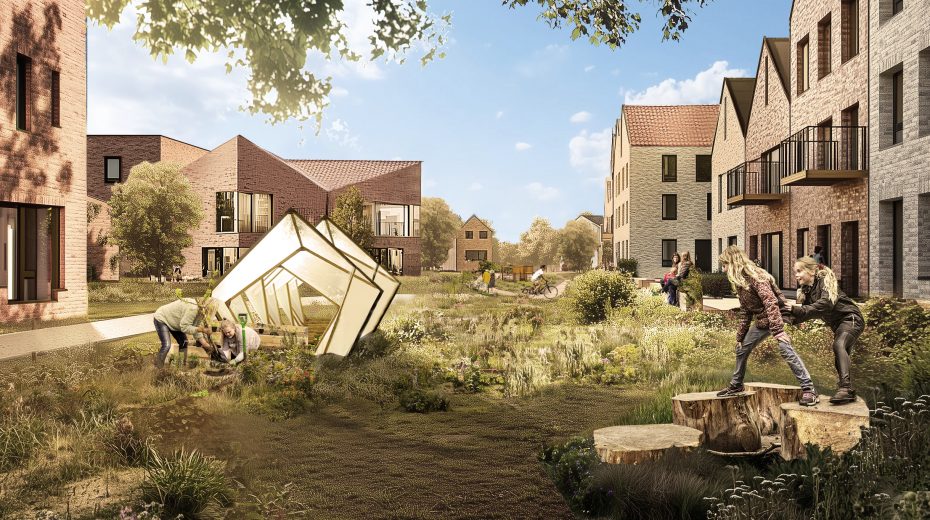
Design spotlight: Nourishing Neighbourhoods
Masterplanners of the future development, Hawkins\Brown explain their research led approach to designing healthy living together.
Over the past 20 years, we’ve seen revolutionary progress in understanding how the environment shapes our mental and physical health. Neuroscientists, public health experts, designers, and many others have advanced pioneering research in the burgeoning field. The moment has come to translate this scientific progress into actionable design strategies to improve lives.
The global pandemic further underscored the urgency of mental health, social cohesion, and the role that neighbourhoods and cities play in supporting healthier lives. At the same time, the UK is seeing one of the largest pushes to increase housing supply since the New Towns Acts of the twentieth century. Indeed, the New Towns Taskforce report to the Government not only emphasised how “design plays a crucial role in shaping the daily lives of residents,” but also that new towns “should be designed to support healthy lives and wellbeing.”
Eddington in North West Cambridge is one such new neighbourhood, designed with health in mind. It is the context of a new research report from Hawkins\Brown, Max Fordham, and the University of Cambridge, which explores the relationship between health and urban design, filling the gap between academic scholarship and design frameworks. Through a systematic literature review, thematic analysis, case studies, and resident interviews, the research distils guiding questions and design moves tailored to Eddington’s context, but which are also replicable across urban and peri-urban settings.
Despite widespread efforts to define what makes a “healthy neighbourhood,” many frameworks offer only clarity in terms of the components that make healthy cities, such as green and blue infrastructure, or a “sense of community”, but leave it to designers to define the details. Designers are left to use their intuition to make decisions and foster healthy environments.
As part of their development of the future phases of Eddington, the University of Cambridge Estates Division commissioned masterplan architects Hawkins\Brown, sustainability consultants Max Fordham, and the Behaviour and Building Performance Research Group at the University’s own Department of Architecture, to conduct a project that would integrate cutting-edge research into the design of the future phases in order to better promote health and wellbeing. Building on the University of Cambridge’s 2013 exemplar masterplan, the new phases seek to sustain its sustainability ambitions while incorporating recent advances in neuroscience, environmental psychology, and post-pandemic insights into public space use.
The research advocates for a holistic approach that links observation, definition, design, and appraisal, aiming to create neighbourhoods that actively support physical, social, and mental well-being. It does not set out a prescriptive design guide but instead presents a series of questions designers should ask themselves to ensure their work responds to the individual demands of context and community. As such, it contributes to a growing body of evidence that urban environments can be designed not just to avoid harm, but to nurture human flourishing.
The full report and accompanying literature review can be found via the Hawkins\Brown website.